D
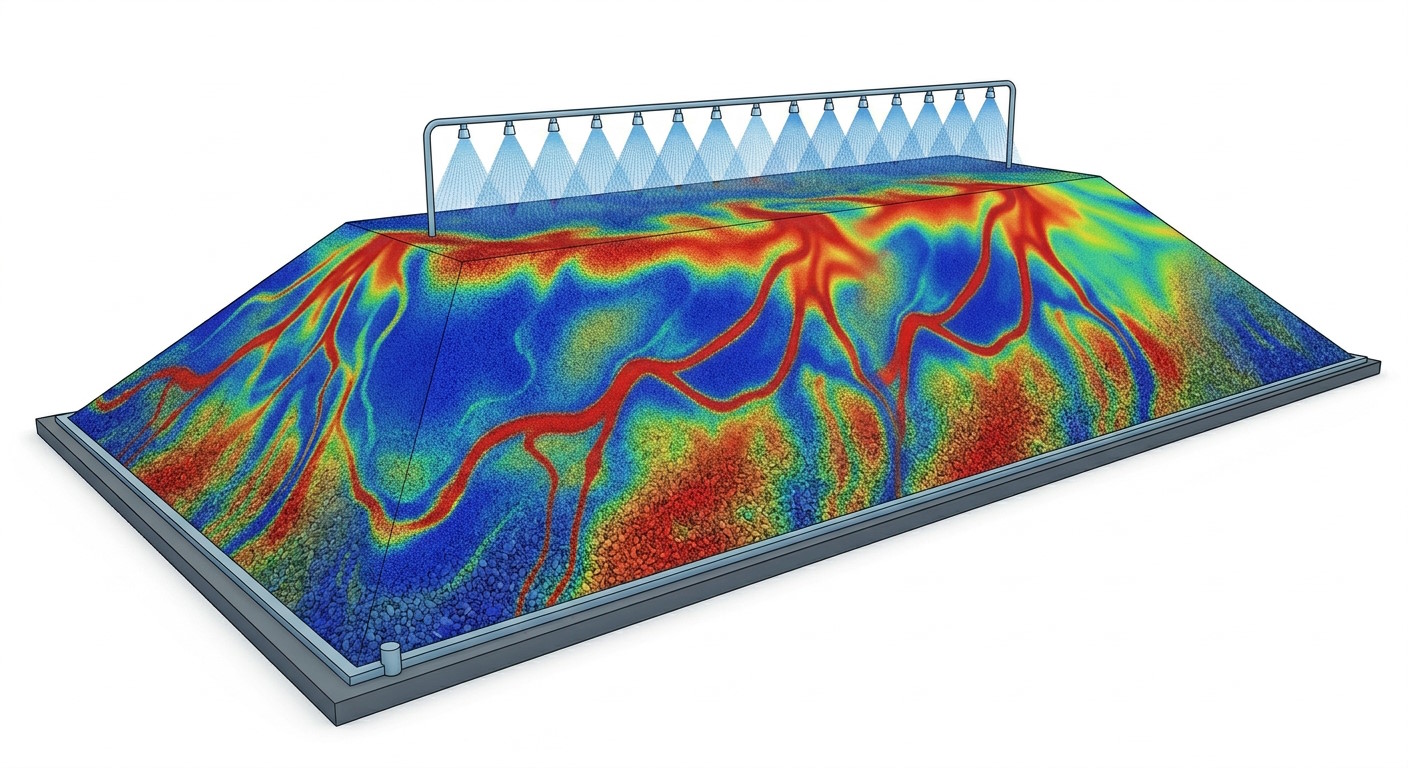
Deep dry zones
Persistent high relative impedance at lower levels or in relevant sectors within the instrumented coverage.
The platform helps identify irrigation patterns and critical conditions within instrumented zones, complementing surface information, global balances and aggregated operating signals.
Phenomena
The objective is to support operational criteria with visual and temporal evidence.
Persistent high relative impedance at lower levels or in relevant sectors within the instrumented coverage.
Localized volumes with low relative evidence of effective irrigation, subject to temporal comparison and operational validation.
Spatial and temporal evolution of relative low-impedance zones associated with irrigation advance.
Local concentrations of relatively wet conditions that may require operational review or comparison with process variables.
Downward or concentration patterns suggesting dominant hydraulic paths.
Relevant spatial differences between sectors, depths or operating periods.
Areas prioritized by severity, location, depth and temporal persistence.
Temporal comparison of measurements to study the response to irrigation changes, operating conditions or complementary variables.
Evidence for reviewing relative irrigation distribution, persistence of critical zones, and operational monitoring or adjustment criteria.
Depth review of the most critical section and manual sweep of cross-sections along the heap.
Temperature monitoring at instrumented points or depths to observe temporal evolution, thermal gradients and internal conditions relevant to operational diagnosis.
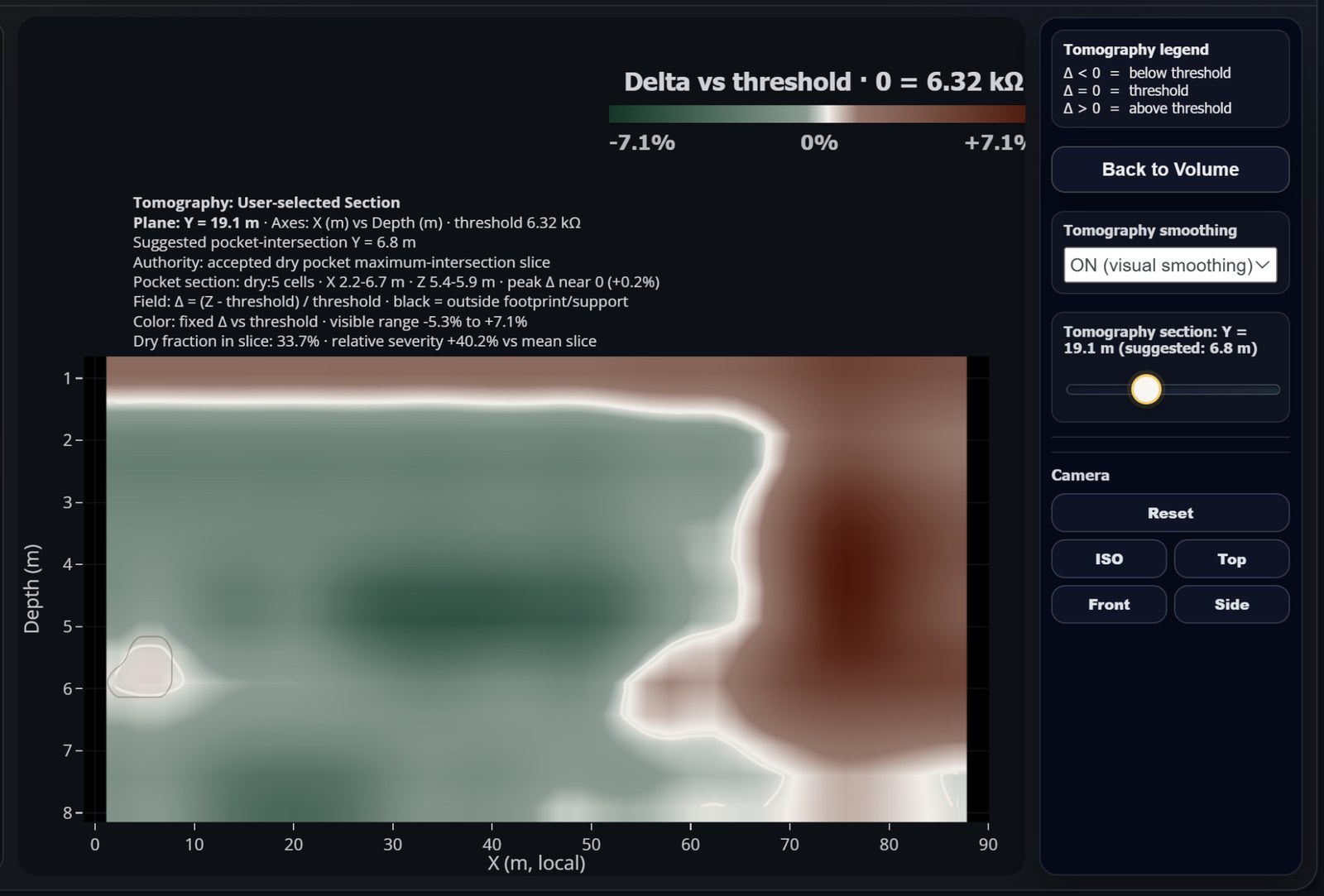
Critical section
Some hydraulic phenomena are better understood in vertical cut than in a surface view. The tomography-like visualization helps review continuity, depth, transitions and critical sectors within the instrumented coverage.
Operation
The goal is not to generate isolated alarms, but to provide evidence to prioritize sectors, compare evolution, and define what should be validated in the field using operational criteria.